
For fans of Star Wars, and aficionados of pop culture history, I would label The Star Wars Radio Dramas: Brian Daley and the Serialization That Saved NPR as a must-read. The narrative style and attention to detail for the people involved in creating this game-changing bit of entertainment media.
The successful immersion of the reader into the history of the Star Wars radio dramas is likely the biggest gift this book can provide, and the importance of reminding people about the impact that the serialized Star Wars radio dramas had on audio drama production at the time. In addition, the book serves as almost a biography of the chapter of author Brian Daley’s life & career around Star Wars and how he dedicated himself to getting those stories adapted and produced for broadcast on NPR.
The book’s chapters walk us through more than just the journey to write, produce, cast the voice actors, and create a finished product worthy of representing everything Star Wars meant. It begins with the story of the creation of NPR, as an almost afterthought to the creation of public television in 1967. National Public Radio didn’t get started until 1971, with coverage of the Senate Foreign Relations Committee Hearings on the Vietnam War in April, and the first broadcast of All Things Considered in May. Yet NPR faced an uphill battle for audience attention and recognition without being able to rely on playing music, which was the primary focus of radio in the public’s mind at the time.
The necessity to bring audiences to public radio was fueled by the idea to revive the long lost of radio dramas, which had long fallen by the wayside by the 1970s. Adaptations of movies, revivals of old serials, and the search for new programming ideas to build a foundation for a new generation of audio dramas was an idea supported by many to just get it right, to create quality radio plays rather than just readings of stage plays.
While there was some small traction on this front, what was lacking was a story that would attract the attention of the masses, and be good enough to capture their attention for the duration. The cultural phenomenon of Star Wars landing on the entertainment landscape in 1977 would turn out to be that missing piece.
From there, the book details the people whose paths crossed to help bring this project to life, to make sure it was lovingly produced with the same care as the original movie had been, and the bulk of that work began with bringing on board or consulting with Hollywood producers and directors who still had connections with old time radio dramas, from John Madden to Richard Toscan to Frank Mankiewicz, leading right to George Lucas.
From the history of how these people and more approached radio drama production and sound design to how they would become instrumental in changing the audio landscape of television and film with sound effects design and the creation of THX, no detail seems to have been missed in retracing the steps and the memories of the key people involved in laying the groundwork to be able to create the Star Wars radio dramas.
Who knew that the creation of the rock opera Tommy for Broadway would lead directly to Star Wars?
Recounting how the deal with George Lucas was struck to get the licensing to produce the radio dramas, after the huge success Star Wars had become at the box office and across the entertainment world, and how Brian Daley was entrusted to write the scripts, thanks to his connection to the franchise and the Han Solo novels he’d written, we get a deep dive into Daley’s life before and after Star Wars. Most of the rest of the book could double as a biography of Brian Daley’s professional writing career, beyond being the writer whose scripts were the foundation of the radio dramas. His dedication and devotion to Star Wars showed in every aspect of getting these produced and ready for broadcast, and was reflected back in the appreciation and dedication of the cast and production teams respect and love for Daley. His profound knowledge of the Star Wars galaxy Lucas had created and the popularity of his Han Solo novels led to his being invited in November 1979 to write the radio drama scripts.
The rest of the book details the casting of the dramas (more than a handful of actors from the films would not duplicate their on-screen performances), production schedules and working with the cast recording the episodes of each movie adaptation. The anecdotes by actor Perry King (once originally considered for the Han Solo role in the films, and took Ford’s place in the radio plays because of his commitments to Raiders of the Lost Ark) are particularly enjoyable. I smiled after discovering that John Lithgow voiced Yoda… how delightful! There were other early Star Wars authors who contributed, both directly and indirectly, to details in the story adaptations to radio (James Luceno and Alan Dean Foster), which for me serves to highlight just how deeply collaborative the galaxy George Lucas created was becoming (and the impact on Star Wars storytelling the novels of the Expanded Universe would start to have). And learning about how the cast endeavored to record well-wishes to Brian Daley while he was in the final stages of his terminal cancer was especially poignant.
For Star Wars fans and fans of radio dramas, this book should be a fascinating read. Anyone who is a fan of pop culture history would also get a thrill from this, and it’s narrative style is deeply engaging. There’s a near-documentary progression of how the idea started and who came together to build the projects with the love, care and attention to detail the Star Wars radio drama adaptations deserved.
Listen to the interview at Slice of SciFi: Talking About “Star Wars” and “Star Trek” History
Four and a half out of 5 stars
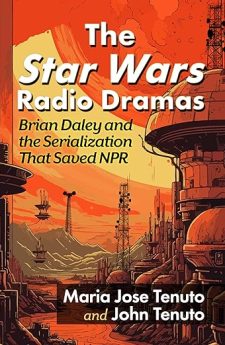 The Star Wars Radio Dramas: Brian Daley and the Serialization That Saved NPR by Maria Jose Tenuto and John Tenuto
By 1977 National Public Radio (NPR) was in trouble, plagued by too little funding and small audiences. The phenomenal success of its adaptation of Star Wars as a radio drama in 1981 gave NPR the needed ratings, publicity, and boost in donations that kept it afloat at exactly the time it was threatened the most. Most importantly, Star Wars brought a new audience to NPR. As it did in theaters, where George Lucas’s films redefined movie making, so too did NPR’s Star Wars forever change the artistic world of radio drama.
That a radio network, dependent exclusively on audio, would find a lifeline in one of the most visually dynamic movies ever released is the stuff of irony. Utilizing new interviews with creatives such as Anthony Daniels (C-3PO), Ann Sachs (Princess Leia), Perry King (Han Solo), and director John Madden, and archival research, this book details how an unlikely alliance of academics, radio executives, Lucasfilm employees, actors, and behind-the-scenes artists banded together, despite the obstacles, to create a unique and consequential work. It is also the story of how writer Brian Daley was the fulcrum who made it all possible.
Publisher : McFarland (July 29, 2024)
Paperback : 213 pages
ISBN-10 : 1476695636
ISBN-13 : 978-1476695631
Reading age : 18 years and up
Author

Telling the History of "The Star Wars Radio Dramas"
Summary
The successful immersion of the reader into the history of the Star Wars radio dramas is likely the biggest gift this book can provide, and the importance of reminding people about the impact that the serialized Star Wars radio dramas had on audio drama production at the time. In addition, the book serves as almost a biography of the chapter of author Brian Daley’s life & career around Star Wars and how he dedicated himself to getting those stories adapted and produced for broadcast on NPR.



Leave a Reply