
How do we envision our future in a world both ravaged by climate change and immersed in the uncertainties wrought by collapsed eco-systems? What difficult choices must be made in a society that desperately clings to the vestiges of past glories? And how will the majority of people living in this future, those who have had no hand in creating this disastrous world, have gained none of the benefits of our current consumption based lifestyles, eke out an existence in the shrunken margins of a faltering society? In Trashlands, Alison Stine details out one potential world that could very well be the future of humanity. This is a tale of climate apocalypse, experienced by those future generations that will pay the price for our flagrant way of life.
Some unknown decades in the future, Trashlands opens on a world wracked by cataclysmic changes as a result of human caused climate change and ecological collapse. The coast of the United States (and presumably the rest of the world, though little outside news penetrates into this great swath of dump) is drastically different. Sea-levels have risen, wiping out coastal cities and lands. Seasons are upset in a warmer climate, and now seem to only be muggy hot or biting cold. Fires burn unchecked, driving those with the most to lose into an uncertain world without any of the support we take for granted now. Animals and plants once abundant are….
But the story of this destruction has never just been about what will happen to the plants and animals of the natural world. But how will the physical and social structures of the manmade realm survive in the new norm of this new world?
The central story arc is about Coral, a young mother desperately striving to find her son who was taken, as so many young children are, to work in the plastic recycling factories. There is no law or government to appeal to, so she is left to try to find him and raise whatever payment she can to try and secure his release. To best make this happen, Coral is voluntarily stuck at Trashlands, which is both a strip club and the surrounding mega-landfill. Coral is a “Plucker”, her days spent plucking plastics from the vast damps of Scrappalachia, hoping to trade the plastic for meager payment.
Trashlands effortlessly weaves the cataclysmic changes wrought by the climate and ecological disasters into the lives of humans unfortunate enough to still be living. Each chapter is told through the point of view of one of 8 different characters. Through shifting perspectives, each of the characters grows throughout the narrative, either through their POV or from their interactions and histories with other characters. The expert telling of these stories, as the characters make their way through a post-apocalyptic landscape shows us exactly how things may ultimately turn for the worst.
Every character’s life has been shaped by fires, floods, or unstable weather patterns. Living in Scrappalachia, a land forgotten by modern society, the natural forces seem to dictate a final and inevitable arrival at Trashlands. The engaging characters and their pasts unfurl through delicate connections made between chapters from the character’s own point of view and as memories and observations of other characters.
Further tying the people to the losses of climate change and ecological collapse, each character is named after something from the present reality which has been lost to fictional future — a drowned city (Miami, Shanghai) or extinct animal (Golden Toad) or plant (Coralroot, False Foxglove, Trillium, Joshua Tree) or even the seasons obliterated by the new unstable climate (Mr Fall, Summer). This intentional naming could have been banal and distracting if the characters and their stories were not so engaging. The names eventually become seamless with the story as a constant reminder of what has been lost in this world, and of all the loss that is still possible.
The ending and denouement raised new questions even as it gave closure for some of the story lines. At first it was frustrating to come to the end of 350 pages and see new possibilities taking shape. Yet so much of the world of Trashlands comes without easy answers, if any at all, making this a suitable ending.
Trashlands excels as a character driven narrative, and deftly weaves themes from current day social issues with the myriad likely issues we will face in an uncertain future. This telling very much shows the reader what it would be like to live in this future. Through the story, the reader may be shocked, horrified, relieved, and at times perhaps a bit ashamed at our own complicity in the polluted future inhabited by the characters of Trashlands.
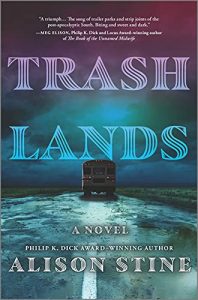 A few generations from now, the coastlines of the continent have been redrawn by floods and tides. Global powers have agreed to not produce any new plastics, and what is left has become valuable: garbage is currency.
In the region-wide junkyard that Appalachia has become, Coral is a “plucker,” pulling plastic from the rivers and woods. She’s stuck in Trashlands, a dump named for the strip club at its edge, where the local women dance for an endless loop of strangers and the club’s violent owner rules as unofficial mayor.
Amid the polluted landscape, Coral works desperately to save up enough to rescue her child from the recycling factories, where he is forced to work. In her stolen free hours, she does something that seems impossible in this place: Coral makes art.
When a reporter from a struggling city on the coast arrives in Trashlands, Coral is presented with an opportunity to change her life. But is it possible to choose a future for herself?
Told in shifting perspectives, Trashlands is a beautifully drawn and wildly imaginative tale of a parent’s journey, a story of community and humanity in a changed world.
Trashlands: A Novel by Alison Stine
Publisher : MIRA; Original edition (October 26, 2021)
Language : English
Hardcover : 384 pages
ISBN-10 : 0778311279
ISBN-13 : 978-0778311270
Author

Summary
Trashlands excels as a character driven narrative, and deftly weaves themes from current day social issues with the myriad likely issues we will face in an uncertain future.


