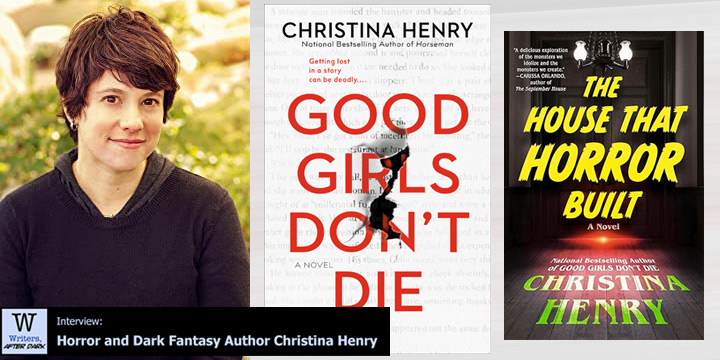
Horror and dark fantasy author Christina Henry stops by to talk about her latest novel, “Good Girls Don’t Die”.
Her next book, coming in May 2024, will be “The House That Horror Built”.
Unfortunately, the audio for this interview was unrecoverable and unusable, so this episode will instead contain the transcription of the interview for your enjoyment:
Summer: Hi, welcome to another Writers, After Dark. I’m Summer Brooks, and we’re here because good stories start with the writers, since wherever there’s a story, someone’s either making it up or writing it down….
And my guest today is one of my favorite horror / thriller / suspense / dark fantasy authors, Christina Henry. Her new book, “Good Girls Don’t Die”, is available to thrill you and intrigue you. And we’re gonna talk about it… Hi, Christina!
Christina: Hi! It’s great to be here again.
Summer: I can’t tell you, like, literally I think “The Ghost Tree” is one of my favorites books of the past five years.
Christina: Oh, that… I can’t even tell you how happy that makes me, because I was so happy when I was writing that book. I think it was just one of the books that I’ve most enjoyed writing, and it’s a book that means a lot to me. So I love it when people tell me that they love it.
Summer: Just to reiterate, I love it. (laughing)
Summer: But your new book is called “Good Girls Don’t Die.” And it’s, narratively speaking, a bit different from your previous stories, because we have, I guess, three intertwining novelettes? Probably the best way to speak to spin spin.
We have three separate protagonists, three separate women, three separate situations of peril, and then they come together. And some of my favorite short story anthologies or film anthologies do they have all these separate story and then all the little spider fingers come together at the at the end and go make you go “whoa, really?” and this one, spoiler alert, I’ve not finished it yet. But we’re on that path and I am very intrigued where you thought, “I need to tell these stories, and I need to tell them together.”
Christina: So this book came out of a very weird instinct. So normally when I write a book, I usually have one image in my head or one phrase or one question that I want to answer. As an example when I wrote “The Ghost Tree,” I just had this phrase in my head “meet me by the old ghost tree” and I ended up writing a whole book so that I could find out what that phrase meant.
And the impetus for “Good Girls Don’t Die” came from a period during the pandemic when I was reading a lot of cozy mysteries and, you know, it was like really comfort food reading. I was just reading piles and piles of them and I thought, “I could write a cozy mystery. Like, I know how this works.” So I sat down to start writing it, and immediately it took a left turn because my brain just doesn’t know how to do anything in a normal way. And I started writing the first section of the book, and then I started to kind of formulate what the story was really about, and I realized there were all these different potential scenarios that I could write, and I actually ended up then writing the third section, and then going back to the second section because even though they all seem like separate stories, they are all connected in a way and then I had to kind of lay in clues of how they were all connected, to lead up to the final section.
Summer: So our protagonists are Cecilia, Maggie, and Alison. And you have the ending part where everything together… and I don’t want to do the spoiler thing!
Christina: Yeah, you can’t spoil this one.
Summer: You can’t, you can’t, you can’t. But each of them finds themselves, in different ways, entangled in a book? Is that the safe way to say it?
Christina: I would say, you know, they’re trapped in stories that they know aren’t their own.
Summer: Okay, that makes sense. We can work with that.
When you started with the third part first, did you intend to write each woman’s story first, sprinkling clues about how they are connected and then write the connecting part, or did you jump back and forth when you sort of sort of realized there’s something deeper about the connections that you wanted to build?
Christina: So when I wrote Celia’s story first and that’s the first section in the book, and then I jumped and I did Maggie story and then I went back and did Ali’s story. And there was a couple of reasons for that. I wanted to have this feeling that the intensity escalates, because there’s a lot of different… Celia is in kind of a cozy mystery scenario, Maggie’s in like a YA dystopia scenario, so there’s a pretty big intensity difference between those two kinds of stories. So I wanted to have something linking.
I also did think about adding another section. But then I decided against it, that I wanted to keep it focused on three. And I was worried, I think, a little bit about not being able to build the tension between each section. When I was working on each section, I stayed in that section, I stayed in that point of view.
Summer: Okay, so from a writing perspective, were you concerned about keeping all the little details separate until you needed to bring them together?
Christina: Yeah, I mean, I think that, you know, I don’t plan anything out and I think that I have a pretty good sense after having written a lot of books… this is actually my 17th book, unbelievably. And I think I have a pretty good sense now of like where things need to be laid in. So I wasn’t really thinking about it in a conscious way, but when I did read all three of these
sections together, the clues and all the little things, little threads that need to be laid in were just kind of there and they did just kind of ramp up.
I’m not a planner when I write. I like to kind of see where things take me and I was surprised honestly in some ways at how well, like the intensity ratcheted up between each section, and how those little clues that give you an idea of what might really be going on, they start to increase as each section goes along.
Summer: I’m trying to avoid spoilers for what I’ve already read…
Christina: I think this is one of the hardest books I’ve ever written to talk about. Even when I sent the book to my agent — because she had no idea what I was writing — I sent it to her and I said, “I don’t know how to describe this to you, just read it.” And she read it and she loved it. And she said, “I had no idea where you were going with this,” which is such a– I felt like a huge honor because she’s been this business for 30 years. She’s seen it all. And she sent it to my editor and she said, “I can’t describe it to you, just read it.”
I feel like this is becoming the catchphrase for this book: “I can’t describe it to you. Just read it.”
Summer: Oh, that sounds like it’s like a version of The Ring.
Christina: Yeah. Yeah.
Summer: So with these characters and their situations, was there… well you said don’t plan anything out. So, I guess there wasn’t, at first, a design for their lives other than each of them is following this story that they have a feeling about.
Christina: Yeah. So there’s one… I think the only really guiding thing that I had for each section was, I was trying to play with the tropes within each genre, and there’s kind of these little discussions at the beginning of each section that could be like, you know, on a message board or on Reddit or something, where people are talking about the different genre tropes. And I think that those were the only things that I was really thinking of, kind of as guide posts, as I went through the story because… it’s so hard now to write something and have your characters not be aware of cultural influences, I think.
I think it’s not realistic that someone in a horror movie scenario wouldn’t realize that they’re in a horror movie scenario. (laughs)
Summer: Oh my goodness, yeah. I’ve seen so many current movies in present day where the teenaged or twenty-something protagonist does something, and the first I yell is “Haven’t you ever watched a horror movie? What were you thinking?”
Christina: Yeah, I mean, you just can’t… and I think that one of the things that I really enjoyed about writing this book was that kind of awareness of tropes and playing with tropes, fulfilling expectations while subverting them at the same time.
Summer: Any thought to intentionally using a trope to mislead someone, a reader, to a clue, so they weren’t aware it was a clue when they got to it?
Christina: There are, I think a couple of things in the book that are clues that people might not realize are clues until the end. But nothing where I was deliberately like, Agatha Christie-like, trying to plant red herrings and like lead you in a different direction or anything like that. I think that kind of writing probably requires more plotting then I’m willing to do.
Summer: Now that title intrigued me when I first saw it, “Good Girls Don’t Die”, and reading the back cover blurb about three different stories leading to a combined end. I’m like, are we gonna have atriple final girl?
Christina: Hmmmm….
Summer: But, it’s still an interesting idea. It’s like, are we gonna have three down to one or we gonna have all three and it literally I can’t spoil because I’m not finished yet, but it’s on my table the rest of this week. But it’s so interesting to find these characters… they’re different, but they find themselves in the same, rather similar unsettling situations, unsettling. There’s just like an unease that you feel them in.
Christina: Yeah, I mean that’s the big thing and the first character in the book — and this is not a spoiler, because it’s like something that’s on the page from the get-go — she’s kind of lost her memories. And that to me is something very, very frightening. This idea that you would be somehow unmoored from your past, and that you wouldn’t know your place in the world because you don’t know what your past is in this world.
And there was a book that I read when I was young, long ago when dinosaurs roamed the Earth, called “The Other Side of Dark” by Joan Lowery Nixon. And it may or may not have been a good book, I don’t remember that, but I do remember that the main character had… she’d been in a coma for four years, and when she woke up she found out her mother had been murdered and the person who murdered her mother had also put her in the coma, and she was the only one who knew who the murderer was, but she couldn’t remember anything. And I just remember thinking how scary that was. You know that anybody around you could be untrustworthy and you would never know because you just don’t remember.
Summer: Wow. Now I’m curious, because that’s sort of that’s dying into the literal unknown. It’s like you’re a established person, but who are you? Everybody knows who you are, but you don’t know who you are. You don’t know who they are. That’s in itself has the potential to be a person’s greatest terror.
Christina: Yeah, and that’s the feeling I was kind of trying to get at I think with Celia’s character in the
the first section, because she doesn’t know who she is and she feels like she doesn’t belong. But everybody seems to know her and she seems to have a place in this town and in her job. But she just keeps feeling “This isn’t right. I don’t belong here.”
Summer: Okay, so we’re not gonna dive into spoilers, but for you, what was the most, I guess, intriguing aspect or trait of each of the three characters, and were you intent to using that to help them get to where they find a way to fix things?
Christina: I think that all three of the characters are, in some ways, like very typical of a lot of the characters that I write, I try to write resilient women. I think that all three of the characters use what knowledge that they have to try to figure out their situations. And I’m always very intent on this idea of showing that there’s more than one kind of strength.
I don’t think that every strong female character is a Black Widow, who punches like a guy and talks like a guy but she’s sexy in her very tight suit. I think that there’s more than one way to be strong, and there’s more than one way to be resilient. And I think that all three of these characters have those qualities in different ways.
Summer: Nice. So what was your approach? I mean, how long did it take to actually write this to get to this format, to where you chose which section write, how you’d work on one character one way… say “We’ll work on the ending for one, then we’ll work on the other character”… What was the, I guess, the process or your writing process on this?
Christina: So I wrote through Celia’s section completely. And that was about a little over a third of the book. And then I wanted to write Maggie’s section. So then I wrote that, and I just wrote straight through chronologically to the end of Maggie’s section. Then I went back, I wrote Ali’s section, and I put it in the middle of the book. I read through to see if all three pieces were kind of hanging together enough. obviously, a first pass, like, you know, just does everything sort of hanging together the way I want it to, and then I wrote the final section.
Summer: So was it was the actual working through, did that take longer or was it the editing? To make sure you have all the pieces in the right places…
Christina: I don’t actually, I’m usually doing some… because I write my hand, and then every like 50 pages or so, I put it in a typed manuscript. So, usually there’s been some editing done already. You know, but just the process of taking it from the notebook into the manuscript, I’m editing, I’m adding, filling in things as I go. And so, that first pass edit, it doesn’t take as long as you might think. I just, usually it’s like, more surgical.
It’s less like big revisions than like I need to add this here, I need to add this here, I need to add this here, and then when I finish the whole manuscript, I do one more pass through, and what I try to do is anticipate the questions my editor will ask. And then once I’ve answered those questions, then I send it. And usually, by the time it gets my editor, it’s like 90 to 95% done.
Summer: Talk about what writing by long hand that first first draft does for you as a writer, a storyteller.
Christina: It’s I think that it makes me a much more deliberate writer. I think that if you can type fast — and I can type fast — there’s a sense of “Well, whatever I put down, it’s fine.” You just type fast, it might not necessarily be the kind of the most thought out writing.
I started writing by hand. It was actually more self-defense than anything. My son was two when I wrote my first book and he didn’t nap all that long and I would have to take him out to the park or something and put him in the sandbox and sit on a bench and write by hand
while he was playing. And I found that the physicality of rating, I think it just slows you down a little bit. I think it makes you a little bit more deliberate. I tend to think a little bit more as I’m going. I just feel like the process… and also that process of writing by hand and being a little more deliberate, stops me from having to do a lot of revisions later, because it’s just slowing you down enough that you’re thinking a little bit more about what you’re doing as you’re doing it.
Summer: I guess you can see you’re actually writing something you’re thinking, “okay, does this really fit where I’m going with this?” And you know, on the computer, it’s too easy to, remove a paragraph and then go back and redo it.
But if you’re if you’re writing longhand hand, you know, hanging out on a park bench watching toddlers play in the sand, you’re distracted enough, but also able to focus better because you’re focusing on writing the words, rather than just what some people call, I guess, barf drafts just blah blah blah blah.
Christina: Yeah, I mean, I know a lot of writers who write like that. They’re like, it doesn’t matter. The first draft, it doesn’t matter.
But I think, for myself, I want to feel like the first draft is almost where I need it to be. When I finish the typing part, I want to feel like “this is almost there.” I don’t want to feel like, oh, I’ve just done this draft. And now I need to draft it two or three or four more times. And just the process, like I said, of slowing down, I think, writing by hand kind of helps a lot with that.
Summer: Nice, nice. So since we can’t talk a whole lot about the story itself, because that would be spoilery and I didn’t want to do that to people, because I’m really enjoying it so far, and they should go read it from themselves… Are you working on your next story?
Christina: So my next book that will be out next year, is actually in the proofreading process now, which means the book has been typeset and now I’m looking for errors in the typesetting. Usually by this point in the process, I’m thoroughly sick of reading my own book! But it’s called “The House that Horror Built,” and it’s about a reclusive director who hires a single mom to come and help him, like clean all of his props and things that he keeps in his house. And of course, he has a mysterious past and probably there’s a ghost.
Summer: Horror movies, old horror movie props and relics, and a ghost.
Christina: Mmm-hmmm!
Summer: I’m intrigued! And when is this one coming out, in the spring?
Christina: It’ll be out in May.
Summer: In May. So we will have that to look forward to. Anything else that you’re involved in?
Christina: Well, I’m working on my 19th and 20th books. It sounds insane when I say that, honestly, just that I’ve been doing this for long enough to have reached that point.
I have a little bit on book 19. I have more on book 20, that’s sort of the order that the publisher wants them to be published in. But we haven’t officially signed the contract yet, so we can’t really talk about them until all that stuff is done.
Summer: So, I have three more books to look forward to. Excellent!
Christina: Yeah, at least three more.
Summer: Cool. Where can we find you online to keep up with your writing exploits?
Christina: I have a website, ChristinaHenry.net. I confess I am a bad blogger. I update it very intermittently. If you want to really follow what I’m doing, in a more up to date fashion, Instagram and Threads. I’m AuthorChristinaHenry all one word in both places.
Yes, I technically still have an account on Twitter, but I am not using it anymore so don’t tag me there. I’m just keeping it open so that nobody impersonates me.
Summer: Gotcha. Totally understood. The exodus of writers from that site I was following is so depressing. It’s really sad. But I also use Bluesky now, so looking forward to reconnecting with folks over there.
Christina: Yeah, I’m also on Bluesky, but I have… I’m not using it quite as much, but I’m trying to… get it going.
Summer: Yeah, you’re not the only one. Everyone I knew who moved over there and they just post maybe one third as much, one quarter as much as they did on the Twitter? And yes, as I’m still calling it Twitter, F that guy.
Christina: Well, yeah, that’s why everyone’s leaving, right? F that guy. (laughing)
Summer: Oh my goodness. (laughing) Okay, we will have links to all of your social media that you’re still updating, and recommending that people go check out “Good Girls Don’t Die”. It is out November 14th, and Christina, thank you, and I look forward to chatting with you again.
Christina: Yes, I can’t wait. Thank you so much for having me.
Website: christinahenry.net
Bluesky: @christinahenry.bsky.social
Instagram: @authorchristinahenry
Facebook: facebook.com/authorChristinaHenry
Twitter: @C_Henry_Author
Listen to one of our previous interviews with Christina about “The Ghost Tree”: Writers, After Dark #69: Christina Henry


Do stories with multiple separate narratives intrigue and entertain you? Let us know! Send Summer an email, or have your say in the comments below!
Chat with Summer on Twitter! @WriteAfterDark
Chat with Summer on Bluesky! @sliceofscifi.com
Subscribe & Review on Apple Podcasts!
Listen on Player.FM
Support our shows!
Learn how you can support Writers, After Dark and Slice of SciFi through Patreon and Paypal


Leave a Reply