I’ve found one of the challenging things about writing horror, or the stories I want to frighten you with, is that often they’re nuanced slow-burns instead of the linearly explosive creature features or romantascares audiences are accustomed to.
The former are simulacrums of current issues—climate, economic depression, deindustrialization and rural abandonment, runaway technology—that necessitate a layered complexity that can be more difficult to fit within an established literary tradition, story arc or hero’s journey.
Full disclosure: I mainly write pulpy page-turners with monsters.
Yet there remains a part of my work that levers horror to write what I see happening in my town, my region, my province.
Frankly, the economic, social, and environmental decline underway in industry towns across North America.
These issues are the type of slow, creeping, dreadful horrors that would appear to not only be real but also inescapable considering our currently dysfunctional governance systems (to my American readers, yeah, it’s dysfunctional in Canada too).
It’s not that we can’t solve them, it’s that the system has so much built up sediment combined with political-soundbitery that we won’t.
Our leaders are largely old men shaking their fists at the clouds while standing atop centuries of layered court decisions and regulations too complex for them to unpack when it’s far easier to name and blame a villain.
That makes all this even more horrific, doesn’t it?
There’s no happy ending here, at least none in sight.
I’ve long been convinced that horror is the perfect literary medium through which we can societally unpack these issues, usher them into the zeitgeist, and capture the political focus necessary to change them.
After all, never was there a government policy change that wasn’t the result of three key elements: a problem, a policy solution, and a story that combines and sells them.
Alas, the industry isn’t tuned to these types of stories, or more pointedly, its current function favours assets likely to generate profit based on what has sold previously, be it story type or author recognition.
In other words, it’s a funhouse of mirrors parroting, twisting, and contorting the same image repeatedly until all that remains is a derivative ugliness.
Fair enough. It’s a business.
As an economics nerd, far be it from me to broadside the very industry we all rely on to reach audiences en masse.
But that’s what makes author Paul Tremblay’s more recent work even more interesting—he’s doing it and his publisher is clearly behind it.
Well done, Paul and imprint William Morrow. Truly.
His latest novel Dead but Dreaming of Electric Sheep is an example of exactly what I’m on about, specifically the terrifying nature of runaway technology, morally vacuous Big Tech, and the absence of any government oversight or intervention.
It leads one woman to remote-control a stranger in a vegetative state across the U.S. a la Weekend at Bernie’s, not because there’s a rainbow at the other side, or succour for her or Bernie, but just to test the tech in exchange for a paycheque because it’s nigh impossible for young people to get ahead these days without selling themselves out.
That’s terrifying.
It’s terrifying because it’s metaphorically true.
Certainly, this is not a horror novel of jump scares, machete-wielding maniacs, or hordes of zombies (I love all those), but it is horrific in how it reflects what’s happening around all of us all the time.
It’s a bit like the frequent argument people have made that we’re turning into an Orwellian surveillance state.
That, while frightening, isn’t what’s underway—what’s underway is much, much worse.
The government isn’t watching us all the time, we’re watching one another—we created the surveillance state through smart phones and social media, our very own digital panopticon.
How does one unpack that?
You can’t.
Thus, the horrors.
Tremblay seems to understand this, and his other recent novels reflect it—both Horror Movie and The Pallbearers Club.
He’s using fiction to scream at us about what we’re already doing, what we’ve unhappily slid into inside of a generation.
A short story I wrote some years ago—“The Ministry of Labour Transition”—did the same thing, pointing out an end state this country could wind up in if it embraced extreme government intervention and climate fearmongering (before you come at me, yeah, climate change is real, I know).
It strikes me the adage that the truth is often stranger than fiction could equally be applied to modern horror—what’s already happening is more frightening than Dracula.
And we’re all participating in it.
And Tremblay is waving the warning flag.
And I hope the publishing industry takes notice and encourages more stories that illustrate it.
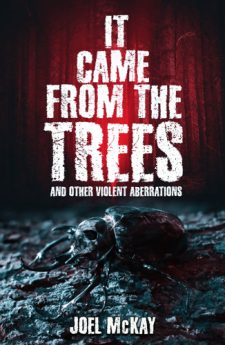 It Came From the Trees: and Other Violent Aberrations by Joel McKay
Winner of the 2025 BookFest silver award for horror and the 2024 Global Book Awards bronze metal for short fiction, It Came From the Trees and Other Violent Aberrations is your retro-pulp style collection of afternoon reads!
Tree planters on the run from parasitic insects. A physicist who has become the target of a murderous airline. Teenagers trapped in a museum with an eldritch horror. An escaped pit fighter thrust into a desperate stand at a sagging mountain fortress. And a luckless cowboy sailing across a sea of grass to the bloody resurrection of an elder god. Welcome to Joel McKay’s It Came from the Trees and Other Violent Aberrations, a collection of five page-turners as strange, disparate and bloody as their titles suggest.
So, grab a stiff drink, turn the lights down low, settle into your favorite reading nook and enjoy this brief but memorable collection of tales from one of the newest voices in Canadian pulp fiction.
Publisher : Birchwood Press
Publication date : January 26, 2024
Print length : 127 pages
ISBN-10 : 1778231241
ISBN-13 : 978-1778231247