
Inspired by true stories, The Long March Home is a gripping coming-of-age tale of friendship, sacrifice, and the power of unrelenting hope.
Jimmy Propfield joins the Army for two reasons: to get out of Mobile, Alabama, with his best friends Hank and Billy and to forget his high school sweetheart, Claire.
Life in the Philippines seems like paradise—until the morning of December 8, 1941, when news comes from Manila: Imperial Japan has bombed Pearl Harbor. Within hours, the teenage friends are plunged into war as enemy warplanes attack Luzon, beginning a battle for control of the Pacific theater that will culminate with a last stand on the Bataan Peninsula and end with the largest surrender of American troops in history.
What follows will become known as one of the worst atrocities in modern warfare: the Bataan Death March. With no hope of rescue, the three friends vow to make it back home together. But the ordeal is only the beginning of their nearly four-year fight to survive.
The Long March Home is set against the backdrop of the Bataan Peninsula in the Philippines. When did you first learn about the Bataan Death March, and why did you decide to write a novel about this era?
MARCUS: It all started about fifteen years ago when Lt. Buck Compton and I were waiting for a plane during a speaking tour. Buck—who’d been a commissioned officer with the legendary Band of Brothers—was talking to me about World War II, and I remarked about the difficulty he’d experienced during the wintry siege of Bastogne.
Buck agreed, then said, “Yeah, but at least I wasn’t fighting in the Pacific. Man, those guys had it really rough.”
That line stayed with me for years.
I began to read up extensively on the era. In 2013, historian Adam Makos and I interviewed veterans who’d fought in the Pacific for our bestselling oral history project, Voices of the Pacific. I grasped more fully what Buck was hinting at then. But I hoped to do more.
When it came to this era, I wanted to take readers right into the action and pathos and connect with not only nonfiction readers but fiction readers too, which ultimately led to the creation of The Long March Home.
TOSCA: Honestly—and this was one big reason I wanted to do this book—I had not heard about the Defenders of Bataan or this harrowing chapter in World War II history until Marcus approached me with the idea of working together on this project.
What a sobering education researching this story has been and what an honor it is to share it with others who, like me, may not be aware of it or its heroes.
The Long March Home is the story of three friends, Jimmy “Propper” Propfield, Billy Crockett, and Hank Wright. Can you provide some background information on each of these young men?
Jimmy is our main character. He’s a good kid, a pastor’s kid, a kid who always tries to do the right thing. He and Claire, Billy’s older sister, have been companions practically since birth, as their mothers are best friends.
Billy, who is a couple years younger than Jimmy, is the happy-go-lucky sidekick.
Hank, the oldest of the boys, is a natural leader, a bad boy, and the kind of kid others want to be around. The only problem is, Hank’s had a soft spot for Claire since meeting her in third grade . . . and Claire is the only girl Jimmy’s ever loved.
Jimmy, Billy, and Hank all make sacrifices at different times in order to help each other and in an effort to survive the war. Without giving away any spoilers, can you mention some of the sacrifices they have to make?
The entire story is about sacrifice on many levels. For Jimmy, it’s the sacrifice of a dream future that doesn’t seem meant to be. For Billy, it’s the sacrifice of what could have been a college career as a track star. For Hank, it’s about claiming—and laying down—his own chance to shine after living so long in the spotlight of his older brother, Cowboy. For all three of them, it’s about doing whatever it takes to keep their friends alive.
Jimmy, Billy, and Hank are determined to survive the unthinkable: “If we have to run—if we have to swim off this island—we’re gettin’ through this. The three of us—all home alive.” Can you provide a couple of examples of how the friends band together in an effort to survive the war?
One of the working titles of the book for a few months during the writing process was All Home Alive. That’s the boys’ goal from the moment they begin to understand what dire straits they’re in.
From the sharing of provisions to their familiar banter in an effort to buoy spirits during the grueling miles of the Death March, the three friends make a constant effort to stay together and protect one another.
The Long March Home includes graphic depictions of war and all the grittiness and horror that come with it. What type of research was required to accurately portray the details surrounding the war?
We wanted to make things as factual as possible, really immersing readers in the locations, events, and characters’ lives.
MARCUS: First, I researched and wrote two nonfiction books about Bataan and the war in the Pacific. The first was the oral history project Voices of the Pacific (2013), done with historian Adam Makos. We interviewed real-life veterans who’d fought in the Pacific. The second was a biography titled A Bright and Blinding Sun (2022) in which I profiled the life of underage enlistee Joe Johnson. He fought on Bataan and survived his experiences as a POW. Both of those books required extensive research and helped create an overall awareness for me that helped with this book.
Then, having Tosca on board was an important piece of the research process too. She came in with a fresh set of eyes and a heart wide open to learning about this era. I had originally started the manuscript directly on the march, but Tosca convinced me we needed several new chapters at the start of the book to bring the reader up to speed on who these soldiers were, what they were doing on Bataan, and how they’d ended up surrendered to the enemy. As usual, Tosca was right.
TOSCA: It was pure selfishness. I wanted to know more about these characters and their lives before, what made them the friends they were, and why they had to survive.
Delving into the four friends’ young lives together in Alabama and then in the Philippines as they are thrust into a desperate, months-long war—not only against the Japanese but also against hunger, disease, and dwindling hope of reinforcements—was fascinating to research, nostalgic, poignant, and finally very sobering to write.
The Long March Home is a dual-time novel. Can you expand on how these two timelines intersect?
The dual timeline is very important to this story. It provides the history of the four friends growing up and sets the stage for their circumstances at the time when the boys enlist in the Army. It also provides a much-needed respite for the reader from the horrors of war as the boys are engaged in fighting and later in their bid for survival as POWs.
What underlying themes can be found within The Long March Home?
We answer that in two ways: Overtly, it’s a story of the power of friendship set against a backdrop of sacrifice. What would you do for the friends you love the most? Then, it also points to the complex morality of life. We often think only in black and white, right or wrong. But life hands us situations in which we are pushed far beyond our comfort zones. This book asks, would you take one life to save another?
What do you hope readers will gain from reading The Long March Home?
An engrossing and inspiring story. Beyond that, insight into an often untaught chapter of World War II history and its heroes and an increased gratefulness for their sacrifice. Today’s generations must remember that freedom isn’t free. Past generations have given much so that we can live for what matters.
Ultimately, this book is about heroes, empathy, and healing—all things that are needed in big supply these days.
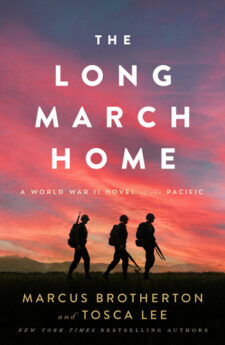 The Long March Home: A World War II Novel of the Pacific by Marcus Brotherton and Tosca Lee
Publisher : Revell (May 2, 2023)
Publication date : May 2, 2023
ASIN : B0BLW7SRLT
Language : English
New York Times bestselling authors Marcus Brotherton and Tosca Lee have partnered on a heart-gripping novel inspired by true stories. Based on the lives of three friends, The Long March Home chronicles the friends’ journey from Alabama to the Philippines during World War II, covering not only the lives and love they left behind but also the impossible odds they face as they struggle to survive what has become known as the Bataan Death March.
Marcus Brotherton is the New York Times, USA Today, Publishers Weekly, and Wall Street Journal bestselling author or coauthor of more than twenty-five books that have been called “fascinating,” “brilliantly arranged,” “magical,” and “refreshingly frank.”
Tosca Lee is the New York Times bestselling author of twelve novels, including The Line Between, The Progeny, The Legend of Sheba, and Iscariot. Lee’s work has been praised as “deeply human,” “powerful,” and “mind-bending historical fiction.”
Websites: marcusbrotherton.com, toscalee.com
Instagram: @marcusbrotherton, @toscalee

